
Fieldnotes from COP 30: Negotiations and Strategies
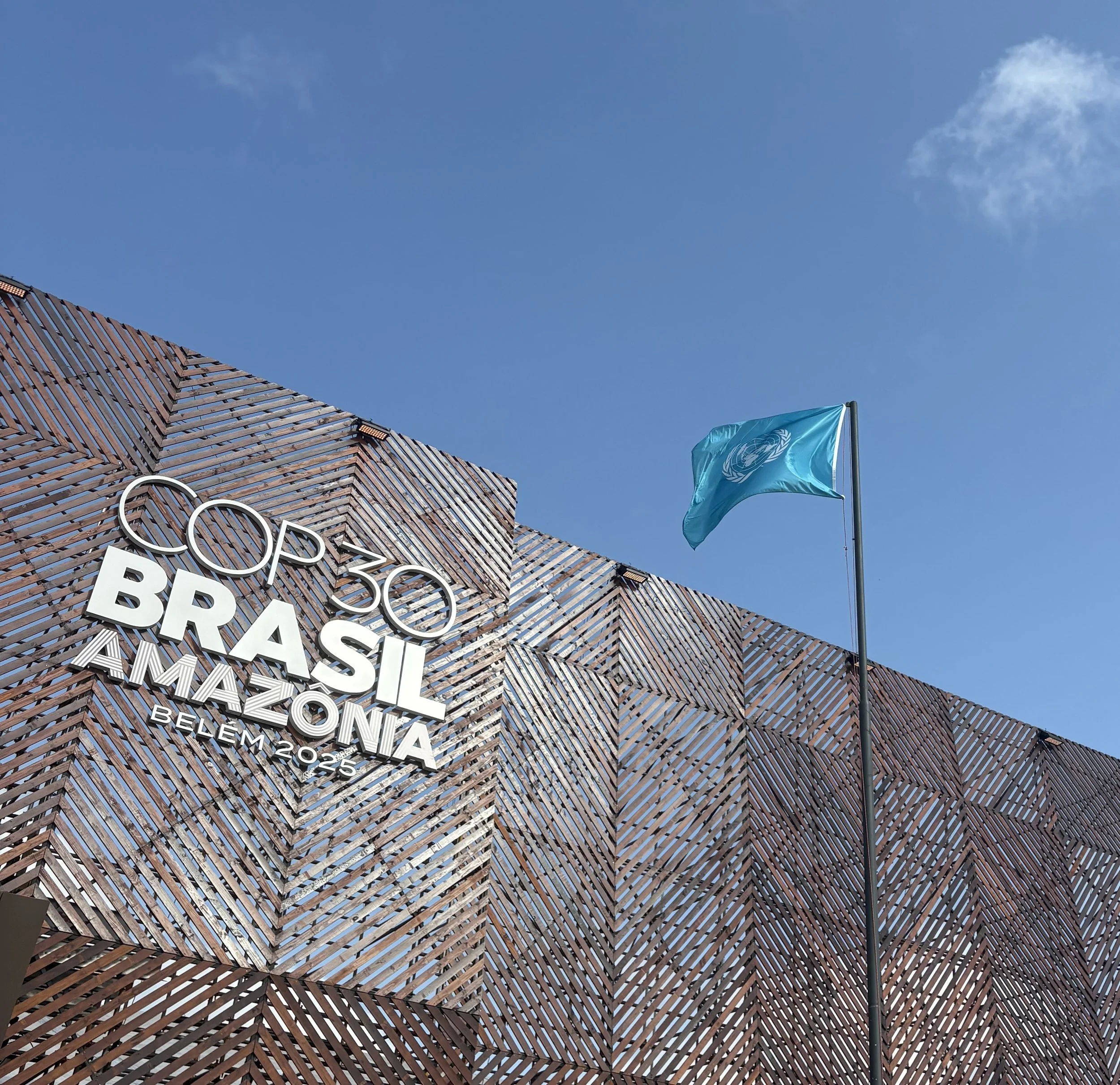
Photo by Carlisle Shore.
This past week, I was given the privilege of serving as a student delegate for UNC-Chapel Hill at the COP 30 climate change conference. Stomaching the irony of the carbon emissions from my trip, I flew to Belém, Brazil, and picked up my observer badge. This badge allowed me access to the venue with the country and NGO pavilions, where different groups held talks about their role in the climate crisis, and also gave me access to what I was most excited about: the negotiation rooms.
COP 30 has gone by many names: the Amazon COP, the Adaptation COP, and finally, the Implementation COP. This last name reflects the COP presidency’s efforts to move COP away from its reputation of being all talk, talk about future talk, and very little action.
Unlike previous COPs, there were no anticipated cover decisions. Instead, negotiators waded through a medley of ongoing dialogues: operationalizing a global goal on adaptation, advancing the Just Transition Work Program, building a functional global carbon market, discussing reforms to the COP process, and more. While not formally on the agenda, the presidency also grouped four key topics—unilateral trade, climate finance, emissions reporting, and ambition through Nationally Determined Contributions (NDCs), which is essentially each country’s emissions reduction goal.
In the spirit of an “Implementation COP”, I tried to follow negotiations about actionable steps toward achieving NDCs, steps that could help us collectively push down the temperature overshoot curve closer to the 1.5C °C warming goal that underpins the 2015 Paris Agreement.
The main threads I followed were:
A) The UAE dialogue on utilizing recommendations from the Global Stocktake (GST), the UN’s tool for assessing collective climate progress, to achieve climate finance and inform NDCs —well, depending on who you're talking to.
B) The Sharm el-Sheikh Mitigation Work Program, which aims to scale up mitigation ambition through finance access, capacity building, and technology transfer. It also provides a platform to discuss a range of topics such as the just transition and circular economies by holding at least two global dialogues per year.
C) Debates over the harmonization of Article 9.1 of the Paris Agreement and Article 2.1(c). Article 9.1 obligates developed countries to provide financial resources to developing countries, while 2.1(c)calls for aligning “financial flows” with low-emissions, climate-resilient development. These talks followed the COP 29 promise to chart a strategy to deliver $1.3 trillion annually in climate finance to developing countries. Much of the debate centered on concerns that sovereign finance (the historical reading of Article 9.1) could be diluted by a new reliance on private finance, which comes with higher interest rates and choosy lending. In my view, a tiered strategy using both streams is necessary. We need a lot of everything—urgently.
The negotiations, admittedly, are highly procedural, chock full of legalese, and often hard to follow. So instead of trying to decode every clause, I started watching the strategies and hunting for subtext. I figured if you are reading the Journal of Foreign Affairs at Carolina, or have even made it this far, you likely have an interest in diplomacy, so below are some of the strategies I saw play out in the rooms.
#1 Grounding. When discussions got lost in procedural weeds—debating whether something belonged in a dialogue or an informal note, or whether it was even in scope—a party (often a Small Island State, mountain nation, or another climate-vulnerable country) would intervene with a sobering reminder of what’s at stake: sea-level rise, displacement, and other looming realities. This often encouraged concessions or raised ambition.
#2 Interests, not Issues: At one point, the Chinese delegation urged countries to speak more directly about their underlying interests rather than hide behind critiques of wording or procedure.
#3 Discrediting Institutions: Questioning the accuracy and composition of structures within the UNFCCC, to delegitimize their recommendations or authority. For example, in negotiations of the Research and Systematic Observations workstream, Saudi Arabia proposed that IPCCC, the UNC scientific body on climate change, should be substituted or complemented with other “accredited scientific agencies.” Delegates I spoke with viewed this as an attempt to bring in research friendlier to delaying fossil fuel phase-outs or over-relying on carbon capture.
#4 Emphasizing Agreements: Conflict remediation 101, but focusing on what you all agree on first and throwing in a small critique or disagreement at the end of the intervention. Like grounding, it brings the room back to a shared purpose.
#5: Mandate, Mandate, Mandate: Constant references to the official mandate were used to dismiss attempts to expand the scope of discussion. This “anti-ballooning” tactic was sometimes strategic, but often seemed like a good-faith effort to keep negotiations focused and avoid overlap with other workstreams.
#6 Running with the Omitted: Parties often leveraged what wasn’t said. If a topic wasn’t explicitly mentioned, some used that omission as grounds for consensus or as space to introduce an interpretation favorable to their interests.
#7 Backdoor Deals: Many agreements are often hashed out before setting foot into the negotiation room. One of the (many) complaints surrounding the US delegation’s absence was the reduced pressure for behind-the-scenes compromises—something for which they were notorious. For example, while standing outside of the negotiation rooms, I saw the UK delegate tap the shoulder of an Italian EU negotiator, verifying they were going to make good on their deal.
#8 Metaphors: This differed by the individual negotiator, but some favored elaborate metaphors over straightforward interventions. For example, one Chinese negotiator compared the presidency’s four key topics to “something old, something new, something borrowed, something blue.”
The list is far from exhaustive. With limited floor time, every word is strategic. At times, the negotiations felt divided and disheartening, but it helped to remember that climate change is a collective action problem. COP negotiations are not peace treaties. While pathways and responsibilities are contentious, the desired outcome—a liveable future—is universally agreed upon.